

Editor’s Note: this is a guest post from Dr. Constantinos Pantidos, a branding expert I met just before the COVID-19 pandemic.
In January 2020, I profiled Dr. Pantidos and his book Living Brands, which traces consumer behavior back to twelve fundamental motives rooted in evolutionary biology. That article remains one of the most referenced pieces in the PublioSTUDIO archive.
Five years later, Constantinos returns with an update on his research and its application across food, packaging, and consumer brands. His framework now extends into an AI-trained platform that translates a brand’s core identity into product decisions at scale.
His new argument: positioning is not the deepest layer of a brand. Positioning shifts as markets shift, competitors enter, and technology creates new options. What should stay constant underneath all of that change is what he calls Brand DNA, the single human motive a brand exists to serve. Strategy evolves. The motive does not.
Reconnecting with him after all this time was a good reminder of why this work is worth doing. Professional development and networking can feel transactional. Conversations with people like Constantinos make it something closer to enjoyable, an actual exchange of ideas rather than a formality.
The following is a guest contribution from Constantinos, reflecting his current thinking on brand strategy and neuroscience.
Before Positioning, There is Something Deeper: The Brand DNA
By Dr. Constantinos Pantidos
Positioning is fundamental to brand strategy.
But positioning is not the deepest layer of a brand.
A positioning is a strategic choice. It defines how a brand chooses to compete and occupy a meaningful place in the market at a particular point in time.
And strategic choices can change.
Markets evolve.
Competitors enter.
Categories blur.
Consumer expectations shift.
Technologies create new possibilities.
A brand may therefore need to evolve its positioning without losing its identity.
This raises a more fundamental question:
What should remain constant when the strategy changes?
We believe the answer lies deeper than positioning.
It lies in the Brand DNA.
Brand DNA comes before strategy
Think about the distinction between three levels:
Brand DNA → Brand Strategy & Positioning → Brand Expression
The Brand DNA answers:
Who are we at the deepest human level?
Strategy and positioning answer:
How should we compete and express that identity in this market, against these competitors, at this moment?
Execution answers:
How should people actually experience it?
These are different questions.
Yet they are often collapsed into one.
A positioning may be developed from category dynamics, consumer needs and competitive opportunities. A purpose may be articulated. A personality may be defined. Values may be selected.
But beneath all of these should be something more fundamental:
the human motive the brand exists to serve.
What if Brand DNA could be uncovered scientifically?
This is one of the reasons we developed THE WHEEL OF MOTIVES®.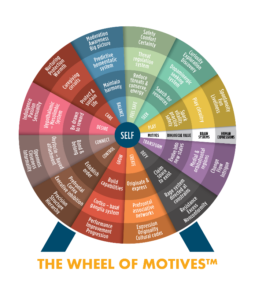
- Proprietary tool developed by BRAND AVIATORS™ See: Dr. C. Pantidos, Living Brands: How Biology and Neuroscience Shape Consumer Behaviour and Brand Desirability, Lid Publishing, London 2018.
The Wheel brings together knowledge from biology, neuroscience, psychology and behavioral science to organize human motivation around 12 fundamental territories:
Feel Safe. Seek. Play. Transform. Defy. Create. Grow. Control. Connect. Desire. Care. Balance.
The purpose is not to select an attractive emotion from a list.
It is to uncover the deeper motivational territory that is authentic to the brand — based on its history, behaviors, products, culture, distinctive characteristics and the role it has learned to play in people’s lives.
We call this its motivational Brand DNA.
And that changes the role of Brand DNA considerably.
It stops being a metaphor.
It becomes the foundation for strategic decisions.
DNA is stable. Strategy can evolve.
Consider a brand whose deeper motivational DNA is GROW.
Its positioning today might focus on helping people learn.
Tomorrow, competitive conditions might require it to position around enabling progress.
Later, new technology might allow it to move into entirely new services.
The positioning has changed.
The underlying human meaning has not.
It is still helping people GROW.
Or imagine a brand rooted in FEEL SAFE.
At one point, safety may be expressed through reliability.
Later through simplicity.
Later still through transparency, predictability or technological protection.
Different positioning.
Different execution.
Same underlying motivational core.
This distinction can give brands something extremely valuable:
the ability to evolve without losing themselves.
But identifying the DNA is only the beginning
Once we know the deeper motive of the brand, another question emerges:
Can we translate it into everything the brand does?
This is where Brand DNA becomes much more than a strategic exercise.
If a brand is fundamentally about FEEL SAFE, that meaning should inform its strategy.
But it should also influence its innovation.
Its products.
Its services.
Its packaging.
Its communication.
Its environments.
Its digital interfaces.
Its customer interactions.
Its sensory experience.
The chain becomes:
BRAND DNA
↓
STRATEGY & POSITIONING
↓
INNOVATION
↓
PRODUCT & SERVICE
↓
PACKAGING & DESIGN
↓
COMMUNICATION
↓
EXPERIENCE
One underlying human meaning, translated through multiple expressions.
From abstract words to physical experiences
This is where the scientific opportunity becomes particularly interesting.
Words such as care, safety, desire, control, play or transformation are abstract.
Products are not.
Products have textures.
Packaging has shapes.
Interfaces have movements.
Spaces have sounds.
Foods have aromas, tastes and mouthfeel.
Materials have weight, temperature and tactility.
If we understand the biological, psychological and perceptual mechanisms associated with a motive, we can begin translating an abstract Brand DNA into concrete sensory and design principles.
The question is no longer simply:
“Does this packaging look good?”
It becomes:
“Does this packaging embody the motivational DNA of the brand?”
Not simply:
“Do people like this product?”
But:
“Does the product make people feel what this brand should make them feel?”
And not simply:
“Is this communication on brand?”
But:
“Is it activating the same fundamental human motive?”
One scientific language across the organization
This could solve a problem that exists inside many large organizations.
The strategy team defines the brand.
The innovation team develops concepts.
R&D develops products.
Design creates packaging.
Agencies create communications.
Digital teams design interactions.
Each function may be excellent.
But each may be translating the brand through its own interpretation.
The consumer does not experience those departments.
The consumer experiences one brand.
A motivational Brand DNA can therefore become a common reference point across the organization.
Not a rigid creative formula.
A shared emotional compass.
The same DNA can produce very different expressions across different touchpoints while preserving the same underlying meaning.
Beyond consistency of appearance
Brand management has become increasingly sophisticated at creating visual consistency.
Logos.
Colors.
Fonts.
Distinctive assets.
Tone of voice.
These remain essential.
But there is another level of consistency that may be even more fundamental:
consistency of meaning.
Two touchpoints do not necessarily need to look alike to belong to the same brand.
They need to express the same underlying identity.
This is the difference between visual consistency and semantic coherence.
And it suggests a different way of thinking about brands.
A brand is not simply a collection of recognizable assets wrapped around a positioning.
It can be understood as a human meaning system.
At its center is a motivational DNA.
Around it, strategy and positioning can evolve.
And from that strategy can flow products, services, packaging, communications and experiences — all different manifestations of the same deeper human idea.
The next evolution of brand management?
For decades, branding has largely moved downstream:
Strategy → Communication → Execution
I believe we can now go one level deeper and much further downstream:
Human Motivation → Brand DNA → Strategy → Positioning → Innovation → Product → Packaging → Communication → Experience
And, importantly, we can begin connecting these levels using evidence from biology, neuroscience, psychology and multisensory perception rather than relying only on subjective interpretation.
That is the ambition behind THE WHEEL OF MOTIVES®.
Not simply to define what a brand should say.
But to uncover what the brand fundamentally means to human beings — and then translate that meaning systematically into everything the brand does.
Because positioning may evolve.
Campaigns will change.
Products will come and go.
Design systems will be refreshed.
But a great brand should always remain recognizably itself.
From theory to application
At BRAND AVIATORS®, we have applied this thinking with both global category leaders and smaller, ambitious brands — because the principle is the same regardless of company size: before deciding how a brand should compete, communicate or innovate, we need to understand what it fundamentally stands for at a human level.
Our work has included organizations and brands across very different categories, including Mondelez International, Nestlé, Coca-Cola, Unilever, BIC, O-I Glass, Ingredion and Hero Group, as well as smaller and emerging businesses looking to build their brands around a clearer and more ownable human meaning.
Across these projects, THE WHEEL OF MOTIVES® has been used not simply to define positioning, but to help connect the deeper Brand DNA with strategy, innovation, products, packaging, communication and experience.
Different industries. Different business challenges. Different scales.
But the fundamental question remains the same:
What is the deeper human motive this brand can authentically own — and how can we make that meaning tangible in everything it does?
Continue your journey at brandaviators.com
Learn more about the book at https://www.brandaviators.com/livingbrands-book.